

Materiality Assessment
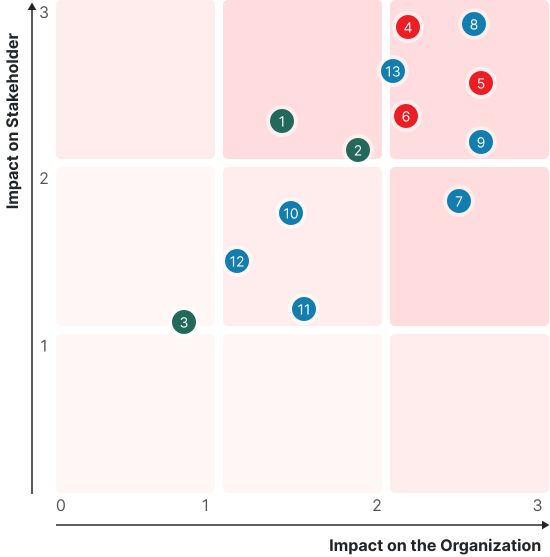
JMT Network Services Public Company Limited has organized a process for prioritizing important issues by considering important issues that have an impact on the company in terms of economy, environment, society and human rights.
The company has prioritized important issues that have an impact on all groups of stakeholders based on consideration of the impact on the company's operations and stakeholders as follows:

Environmental Dimension
-
1Resource management
-
2Climate Change
-
3Biodiversity

Social Dimensions
-
4Human Rights
-
5Employee Care and Capability Development
-
6Community Engagement

Economic Dimension
-
7Sustainable Returns
-
8Service Standards and Fair Communication
-
9Data Protection and Information Systems
-
10Innovation and Technology
-
11Sustainable Supply Chain Management
-
12Anti-Corruption
-
13Corporate Governance, Risk Management, and Regulatory Compliance
Material Issues Review
The Company conducts an annual review of material sustainability issues to ensure they remain aligned with the business context, organizational strategy, relevant laws, and evolving stakeholder expectations, by considering the dimensions of economic, social, and environmental impacts, as well as risks and opportunities that may affect the financial position and operating results of the Group. The review results are presented to the Board of Directors for consideration and approval prior to disclosure in the annual sustainability report. Additionally, the Company reports sustainability performance progress to the Board on a quarterly basis to support ongoing oversight and monitoring, and prepares an annual comprehensive performance report for transparent and auditable disclosure to all stakeholders.
Material Issues Identification Process
JMT Network Services Public Company Limited (“JMT”) conducts the identification and prioritization of material sustainability topics based on the principle of impact materiality. This approach is used to identify and assess the actual and potential impacts arising from the Company’s business operations on the economy, society, and relevant stakeholders. The Company focuses on impacts generated from its activities throughout the entire value chain. The process for identifying and assessing material sustainability issues is outlined as follows:
This Sustainability Report has applied the sustainability reporting standards of the Global Reporting Initiative (GRI) GRI Standards 2021 and the UN SDGs in the reporting process to ensure transparency and compliance with international standards. In addition, the Company takes into account the principle of Impact Materiality or the importance of the impact on business operations in order to be able to disclose information about highly significant sustainability issues completely and clearly. In this process, the details of the content are as follows:

1. Understanding the Organizational Context
The Company analyzes both internal and external organizational contexts related to its non-performing asset management business (NPL/NPA), by considering internal factors including corporate governance structure, risk management and internal control systems, legal compliance, fair debt collection policies, and data management and information technology systems, alongside external factors such as economic conditions, interest rate trends and credit quality, government laws and regulations, industry standards, social expectations, and technology risks. Such analysis covers the entire value chain, from debt portfolio bidding, debt management and collection, debt restructuring, through to data management, in order to understand the conditions that may give rise to impacts on stakeholders from the Company's business operations.

2. Identification of Actual and Potential Impacts
The Company identifies both negative and positive impacts, whether actual or potential, arising from the Company's activities and business relationships, by considering impacts on the rights and dignity of debtors, fairness in service delivery, quality of life, data privacy, economic security of relevant parties, and public confidence. Impact identification is conducted through gathering opinions and complaints from stakeholders, analyzing past incidents, reviewing relevant legal requirements and standards, as well as internal discussions with relevant departments. In this regard, the Company considers whether such impacts are caused directly by the Company's operations, contributed to by the Company, or linked through business relationships.

3. Impact Assessment
The Company assesses the significance level of impacts using defined criteria, namely likelihood of occurrence, severity of impact, scope of impact, and remediability. In assessing negative impacts, the Company places primary emphasis on the severity of the impact, particularly on issues relating to human rights and fairness, while positive impacts are evaluated based on the number of beneficiaries, continuity of outcomes, and the enhancement of quality of life or economic security of relevant parties.

4. Prioritization and Determination of Material Issues
The Company prioritizes assessment results whereby issues with high impact levels or broad scope affecting stakeholders are designated as material sustainability issues. Such issues are then used to define management approaches, key performance indicators, and disclosures in the sustainability report, as well as being reported to the Board of Directors for ongoing oversight and monitoring.
